
Publication Title: Biofluid-specific variations in circulating 5′ transfer RNA fragments during ictal and interictal states in experimental temporal lobe epilepsy.
A group of PRIME researchers collaborated to publish a paper in Epilepsia – authors: Marie Soukupova1*, Elena Perez Morrissey2,3*, Annunziata Guarino1, Pietro Marino1, Cristiana Pareo1, Nicolò Birtolo1, Saad Zaheer2, Rachel Stewart2,3, Ina Woods2, Felix Rosenow4, Hajo Hamer5, Péter Körtvélyessy6, Shona Pfeiffer2, David C. Henshall2,3, Jochen H.M. Prehn2,3,#, Michele Simonato1,7#.
Published 13 April 2026.
Link to read the publication: https://onlinelibrary.wiley.com/doi/epdf/10.1002/epi.70246
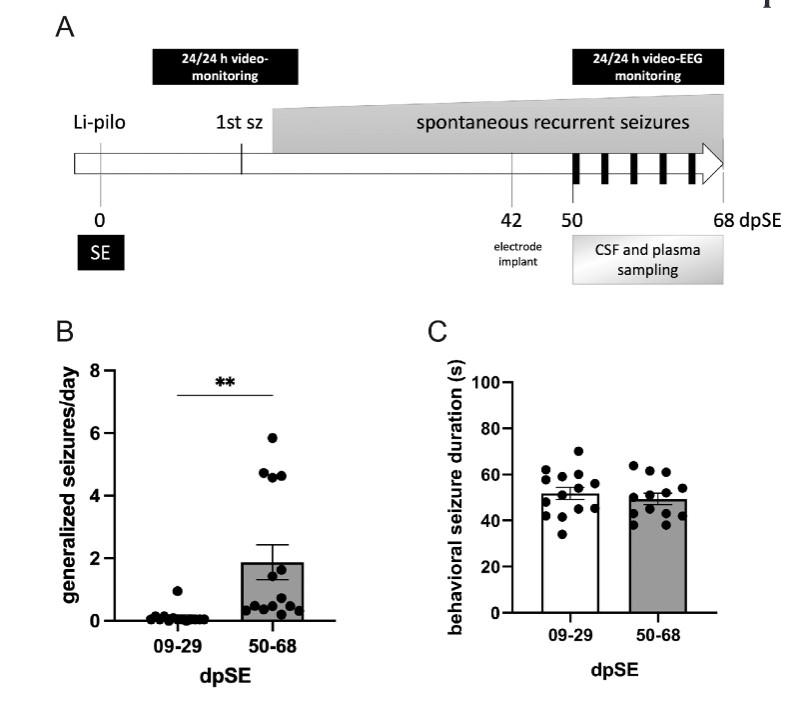
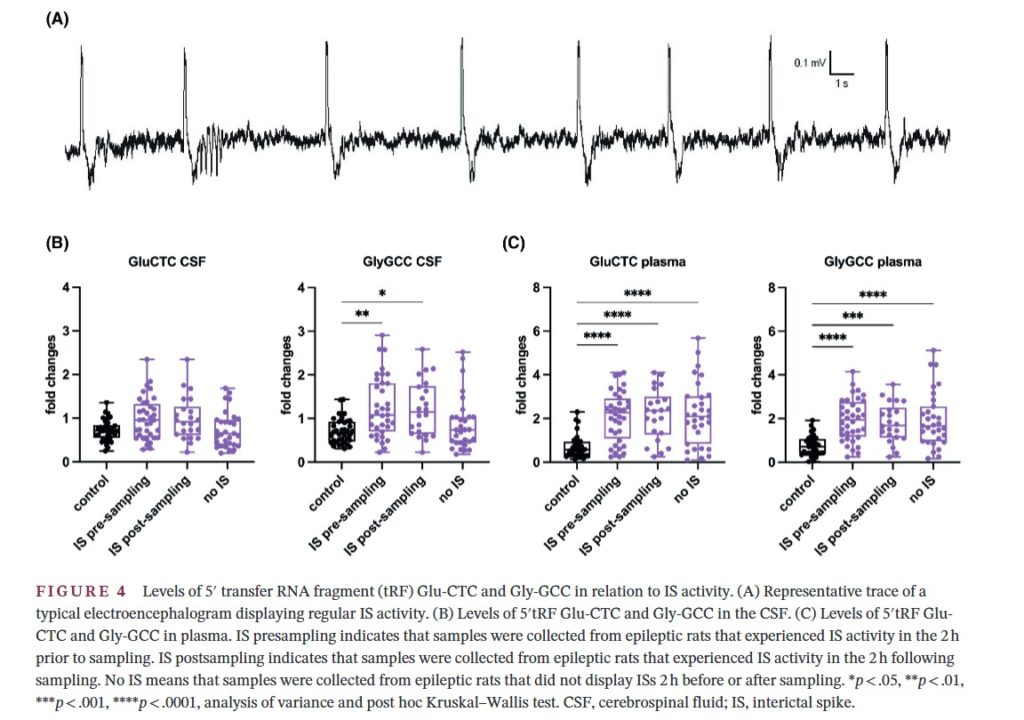
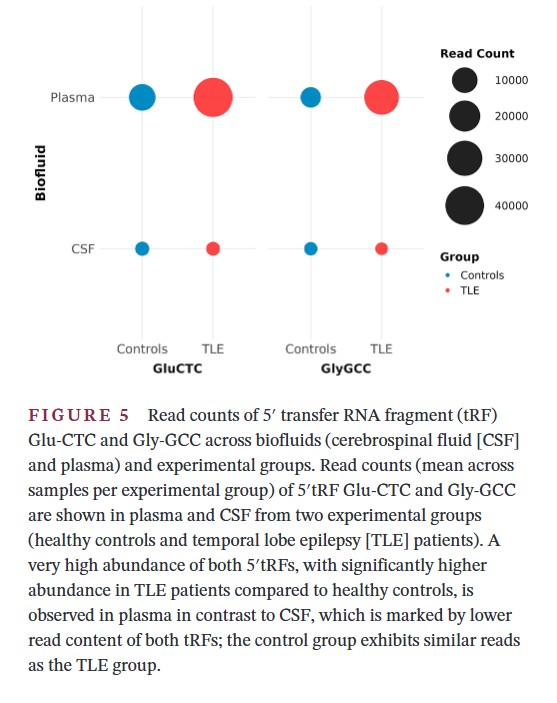
The study evaluates two transfer RNA fragments (5’tRF Glu-CTC and Gly-GCC) as biomarkers for temporal lobe epilepsy. Using rat models and human samples, researchers found these fragments significantly elevated in plasma, though levels didn’t correlate with seizure frequency. Notably, CSF levels of 5’tRF Gly-GCC mirrored interictal spike activity, suggesting these fragments serve as accessible diagnostic tools for monitoring epilepsy.
This research looked at specific molecules called tRFs—tiny fragments that work within our cells’ genetic machinery—which change in level when the brain is affected by epilepsy. We discovered that both people and animals with epilepsy have much higher levels of these fragments in their blood compared to healthy individuals. This is exciting because it means a simple blood test could one day help doctors diagnose epilepsy more easily, without always needing expensive or invasive brain scans. We also found that while the blood tells us if someone has the condition, the levels of these fragments in the fluid around the brain change based on electrical activity between seizures. This could help doctors understand how epilepsy affects each individual patient.

The real-world impact of this research lies in moving epilepsy diagnosis toward more efficient precision medicine through proactive monitoring. Currently, diagnosing epilepsy can be a long, stressful process involving hospital stays and extended EEG monitoring. This discovery is a step toward a simple blood test that would provide a quick, accessible diagnosis at a regular doctor’s office. On a personal level, by measuring the fragments identified in the study, doctors could also track how well a treatment is working in real-time. Monitoring tRFs in blood could make the management of epilepsy safer, faster, and much more personal.
Under the PRIME project, we aim to use the tRFs identified in this study to trigger a personalized therapy. To do this, we are developing engineered cells smart enough to detect rising tRF levels and automatically release a therapeutic agent (GDNF) to stop a seizure before it even starts.
In the future, these smart, tRF-sensing cells could be housed in a tiny, implanted device that monitors brain activity in real-time to provide ‘on-demand’ anti-seizure treatment. Success in this phase would pave the way for clinical trials with pharmaceutical companies, offering a personalized, automated cure for patients who don’t respond to traditional medication, significantly improving their daily quality of life.
This research was a collaborative effort involving many experts across different fields. As the saying goes, ‘If we have seen further, it is because we are standing on the shoulders of giants.’ Our work builds upon years of foundational neuroscience, and it is only through this collective teamwork and the discoveries of those before us that we can now dream of a future with personalized, automated cures for epilepsy.
Link to read the publication: https://onlinelibrary.wiley.com/doi/epdf/10.1002/epi.70246
1Department of Neuroscience and Rehabilitation, Section of Pharmacology, Via Fossato di Mortara 17-19, 44121, Ferrara, Italy
2Department of Physiology and Medical Physics, RCSI University of Medicine and Health Sciences, 123 St. Stephen’s Green, Dublin D02 YN77, Ireland
3FutureNeuro Research Ireland Centre, RCSI University of Medicine and Health Sciences, Dublin D02 YN77, Ireland
4Epilepsy Center Frankfurt Rhine of Goethe University, Frankfurt, 60528 Frankfurt am Main, Germany
5Epilepsy Center, Dept. of Neurology, University of Erlangen-Nürnberg, Kopfkliniken, Schwabachanlage 6, 91054 Erlangen
6Department of Neurology, Charité – Universitätsmedizin Berlin, Corporate Member of Freie Universität Berlin and Humboldt-Universität zu Berlin, Berlin, Germany
7Division of Neuroscience, IRCCS San Raffaele Scientific Institute, 20132, Milan, Italy